Héctor Zamora is a Mexican artist based in São Paulo, Brazil, who has made public space a significant part of his practice. His major works blend the situational and the surreal, encouraging the inhabitants and users of a space to see anew its specific architectural character. Zamora’s interventions are playful in their seriousness and ironic in their humour. He prefers an allusive subtlety rather than anything too bluntly obvious or coercive. The audience must make its own contribution of insight and empathy to the environment the artist has created, and to quote from the 1964 musical movie adaption Mary Poppins, a spoonful of sugar helps the medicine go down.
In her famous 1929 essay ‘A Room of One’s Own’, Virginia Woolf proposed that one of the key ingredients in the creative process was a private, personal space to occupy. In the aftermath of the Christchurch earthquakes of September 2010 and February 2011 widespread damage and chaos meant that finding room of one’s own became a very difficult prospect. Zamora’s installation Muegano inspires passers-by to reflect on the traditional house structure in Western culture as well as the stylised, schematic way young children draw houses. As a comment on inner-city living and urban density, the artist saw this project as a way to examine urban Christchurch, just as the earthquakes have caused the people of Christchurch to re-evaluate their relationship with public space and the built environment.
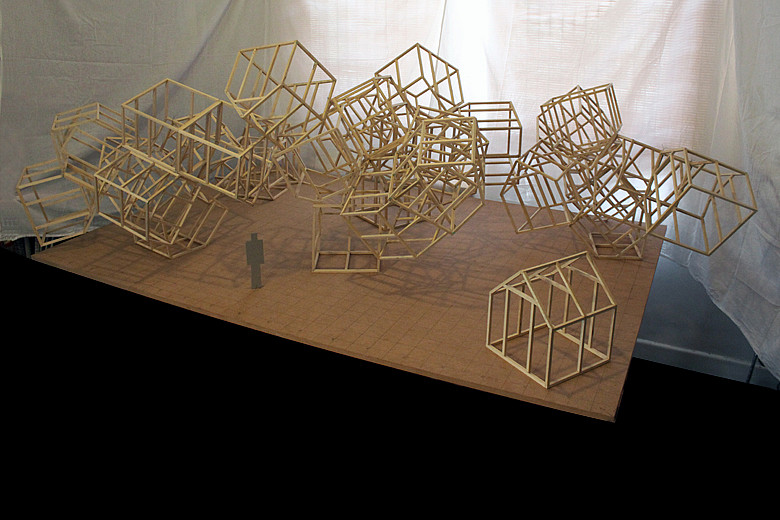
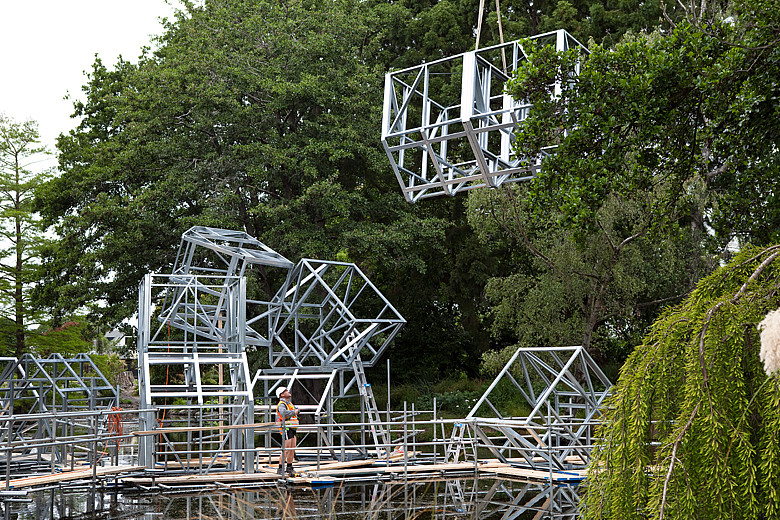
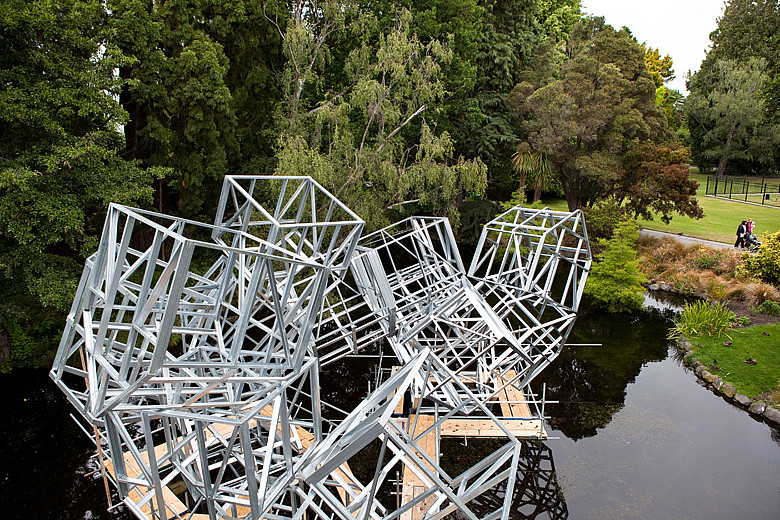
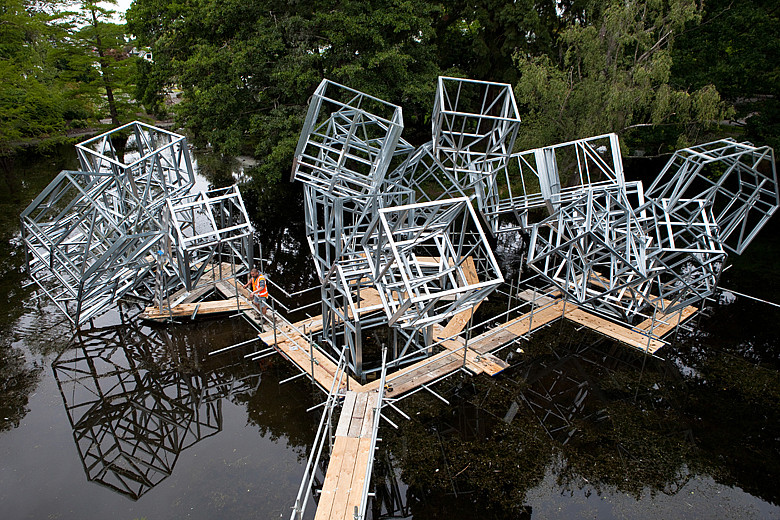
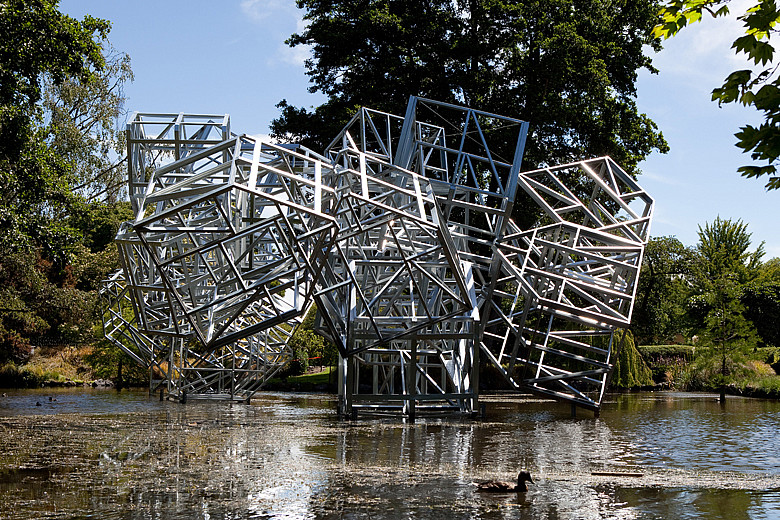
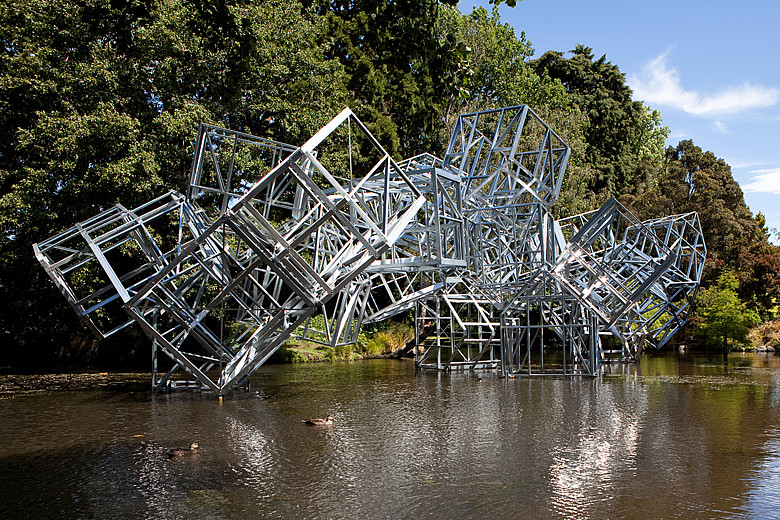
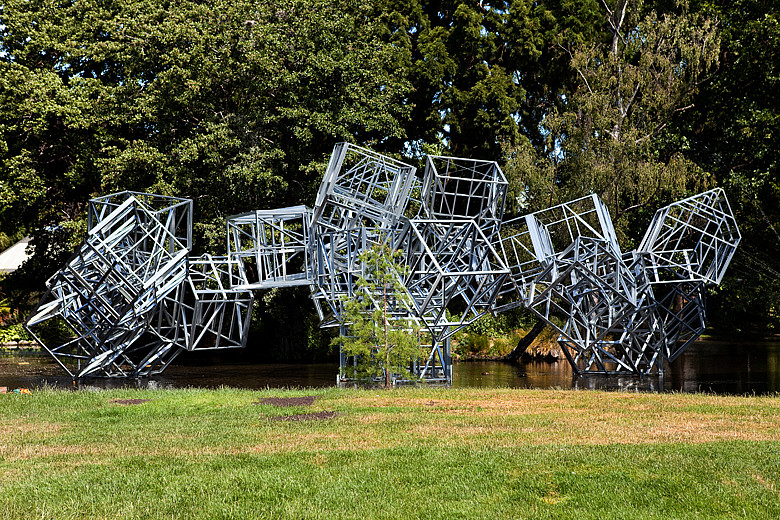
Muegano was conceived prior to the earthquakes after a 2009 visit to Christchurch’s suburbs. In Mexico a muégano is a sweet made by frying little cubes of dough that stick together in clusters; suggestive of the basic form of the installation. Muegano creates an aggregation of quasi-private loci amoeni in public space. The individual units consist of greenhouse frames, cuboid with gabled roofs, but open to the elements like some kind of architectural maquette. Comparisons can be made, perhaps with the brutal steel geometry of Vladimir Tatlin’s proposed Monument to the Third International of 1920, and some of the ideas behind Rachel Whiteread’s 1993 House. We are encouraged to re-evaluate and re-imagine the definition and nature of the dwelling.
Of the work, Zamora says: The origin on the idea came from a very simple reflection about this very symbolic house shape, that for western cultures is an iconic image that we learn since we are very young to refer to house or home. I see that basic house shape as one simple but charged full of human cultural symbolism. But when we see houses with that shape, the last thing that we think is that it is a natural organic construction. The first thing that we probably think is that it is a non-organic, human made, industrialised structure, but if we rethink a bit we are another animal of this world, all things that we are producing and creating (even the more sophisticated ‘artificial things’ are made with the resources that this environment is giving us, we are not creating new matter, we just change, modify, destroy and reconfigure that, as all the other live organisms in this planet), then this house shape can be seen as an anthill. Then it is a sophisticated solution that can protect us from the natural environment, we arrive at that solution not because it is nice, it is something functional.
On some levels the form is fractal and crystalline, something magical and utopian, Romantic, part of a lineage that runs to the glass Alpine fantasias of turn-of-the-century German architect Bruno Taut, and nineteenth-century German painter Caspar David Friedrich’s Sea of Ice, 1823–24. Unlike many of Zamora’s public works, Muegano is more of a classically constructavist sculpture. It lacks the element of the unexpected surreal intervention, the alien interloper, apparent in the zeppelin he created for the 2009 Venice Biennale, but it is directly related to Zamora’s practice of heroically scaled site-specific installation practice.
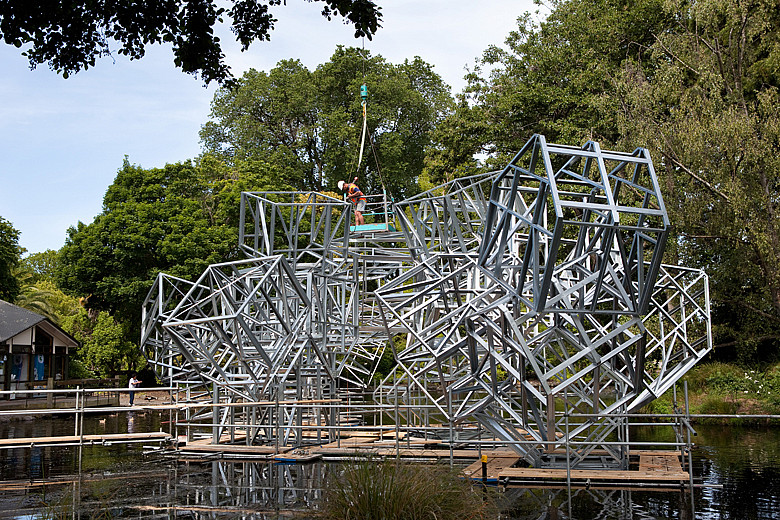
The installation occupies a picturesque site by Kiosk Lake next to the Information Centre and Children’s Playground in the Christchurch Botanic Gardens. The jumbled together nature of the structural units, piled up and even upside down, perhaps unwittingly evokes something of the terrible damage done to Christchurch’s urban built environment by the earthquakes and subsequent demolitions. When Christchurch’s earthquakes hit, Muegano was still under construction in Victoria Square, which at once became an inaccessible site. Zamora, a survivor of the 1985 Mexico City earthquake, was immediately empathetic with the people of Christchurch and at the time questioned whether the work would be appropriate when the city was still experiencing regular seismic activity. If anything it now seems very fitting. Zamora says: Now with the artwork on an artificial lake inside of the botanical garden, the artwork is getting unexpected resonances that I am still trying to understand... probably now the greenhouse as a mini botanical garden inside of the botanical garden can establish some connections referring to how we are domesticating nature... and how nature will always have the last word. We know that we will not end with the planet, we probably can end ourselves but the planet will continue...
text by Andrew Wood